
Case Studies & Testimonials: Tips for Better Testimonials & Common Mistakes to Avoid

Why testimonials work
Case studies and testimonials are powerful because they let your audience hear from a real human with real stakes, not only a brand voice. And that matters in healthcare, where skepticism is high, and credibility is fragile.
But there’s a hard truth: your KOLs are rarely trained presenters. They’re experts in their field, and your job is to share that expertise without forcing them to act like a commercial spokesperson.
In most categories, you can track a click to a purchase. In healthcare, that path is rarely clean. Devices and diagnostic tests aren’t bought online, and even when interest is high, the decision path runs through committees, protocols, and procurement.
When conversion is hard to measure, credibility is what keeps your brand in the conversation long enough to win.
The first 15 seconds decide everything
In the first few seconds, don’t let viewers feel like they’re being sold to. Don’t lead with the brand name, and don’t lead with the logo. The testimonial should not open with your logo, product name, or anything that screams “ad”.
The opening needs to earn attention by landing on something the viewer immediately cares about: a problem, a moment, a pressure point, a result they recognize.
Then, once they’re engaged, you can introduce the brand and connect the story to the solution. That sequencing is a strategic decision, because attention drops fast and you don’t get unlimited time to recover it.
Stop Scripting
One of the most common mistakes healthcare marketers make is trying to script a clinician, patient, or customer to deliver perfect “marketing legalese” line-for-line. It doesn’t work because it’s not how real professionals speak, and it reads as staged immediately.
You’ll get the stiff cadence, the unnatural wording, and the “I’m reciting something” look that makes viewers click away. And you don’t just lose engagement, you lose trust.
The content may be technically accurate, but it won’t feel true.
A better approach is a guided conversation. Use follow-ups that pull for specificity. Build an interview flow that helps the subject get to the point in their own words.
The goal is not to control every sentence; it’s to capture usable, credible material without turning a clinician into a teleprompter reader.
Interviews are a Performance
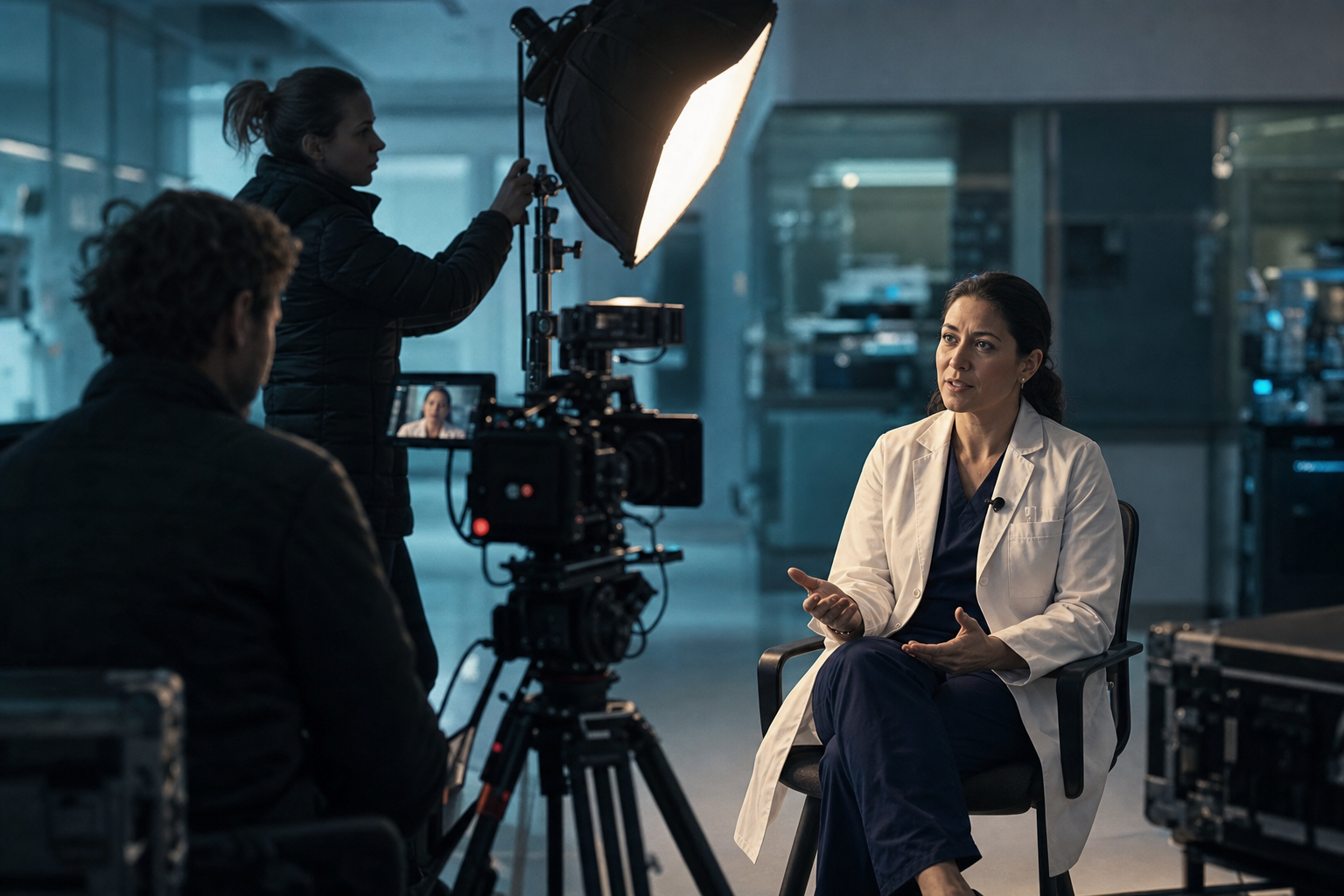
Cameras change people. Even professionals can freeze, ramble, or second-guess themselves the moment they feel watched, and especially when they realize they’re being recorded and will be watched repeatedly.
That’s why testimonial quality is rarely a “talent” problem. It’s usually a comfort problem. When someone trusts the crew, they stop performing and start talking like themselves. When they don’t, answers turn mechanical because the camera feels mechanical.
The fix looks simple on the surface, but it’s intentional. Pre-interviews help you understand the story before the lights go up. Briefs help the crew walk in already oriented to who they’re meeting and what matters to them.
On set, small choices like how you speak to the subject, whether you rush them, and whether you interrupt them will show up in the footage more than most expect.
Pre-Production is Where Testimonial Quality Gets Decided
When marketers talk about testimonials, they usually talk about questions, messaging, and approvals. All important. But the work that determines whether a testimonial is even possible often happens earlier: scheduling, permissions, and logistics.
On paper, conferences sound like the perfect content opportunity, one place, one city, and a rare moment when customers, partners, and KOLs are physically present. In practice, conferences are policy-heavy environments designed to monetize access and control what vendors can do on the floor.
Many conferences make it expensive and difficult to bring in your own crew because they want exhibitors to use their preferred on-site vendors. Those vendors are typically audiovisual specialists for live events, not marketing teams building content for social platforms and post-event campaigns. Different job, different tools, different priorities.
Testimonials at the Booth
A common pattern for small and mid-sized brands is building an aggressive conference schedule: pack the day, rotate customers through, and walk out with a library of testimonials.
Then the conference arrives and you get one KOL. Maybe two.
Customers have limited time at the event. They have competing priorities. And even if they want to help, their institution may restrict whether they can appear on camera at all, and what they’re allowed to say.
Identify who’s likely to participate, confirm permissions, and build a schedule that respects how HCPs move through a show.
Two cameras and B-roll are insurance
A testimonial might start as a 20-minute conversation on the low end, and run 45 minutes to an hour on the high end. The deliverables are usually three to five minutes. For paid and social, it might be 30 seconds to two minutes.
A second camera angle gives the editor room to cleanly compress answers—cutting between angles so the final statement feels fluid instead of chopped up. B-roll gives you an additional layer of protection. If the speaker references a workflow, a device, a lab process, data on a screen, or a patient journey, B-roll gives the viewer something concrete to look at while the story is being shaped.
B-roll should match what’s being discussed. If the visuals feel unrelated, it triggers a negative reaction, and you’ve undermined the whole point of a testimonial.
Short form vs long form
Many healthcare teams still default to a three-to-five-minute testimonial.
Content whose purpose is to build a following and generate leads, that middle is often the worst value. What we’re seeing is a split: short and long are driving results, and not in between.
Short-form (around 30 seconds or less) is how you earn attention and trigger curiosity. Long-form (around 40 minutes and up, depending on the topic and audience) is where you can actually deliver enough information to create conviction.
The practical model is to build one real long-form conversation and then cut it into multiple short clips.
One proven format is podcast-style video: multi-camera, a host, and a subject talking for 20–30 minutes. From that single shoot, you can deliver the full long-form cut, the audio-only podcast version, and 5–10 shorts designed for social.
Those shorts drive viewers back to a channel where the long-form content lives, and the long-form content does the heavier job of educating and converting.
Conclusion
Testimonials don’t fail because the subject isn’t impressive. They fail because the process forces them into a performance, the opening signals “ad,” or the production choices leave you no way to shape the story without damaging credibility.
If you’re planning testimonials, use this episode as your checklist before you lock schedules and book crews.
Q&A: Case Studies & Testimonials: Tips for Better Testimonials & Common Mistakes to Avoid
Why do testimonials work in healthcare?
They borrow credibility from real clinicians when trust is hard to earn. They also help when you can’t easily measure conversion like e-comm.
What should the first 15 seconds do?
Lead with the problem or outcome. Don’t open with logo/product—people see an “ad” and drop.
What’s the most common testimonial mistake?
Over-scripting. It makes clinicians sound staged, which hurts trust.
How do you get natural answers on camera?
Make it a guided conversation, not a script. Comfort + good follow-ups beats “perfect lines.”
What’s the simplest way to protect editability?
Use two cameras and relevant B-roll. It lets you cut tighter without jumpy edits and keeps visuals believable.

While you're here
A few more pieces from the team on healthcare marketing, AI, and the work behind the work
.png)
.png)

Trusted by the teams shaping healthcare
Real perspectives from the healthcare and life science teams who've trusted DigiVidBio with their campaigns, their science, and their reputations.

Your story
starts here
Whether you have a clear brief or just a challenge worth solving, we're ready to dig in. Send us a note and we'll get back to you within one business day.